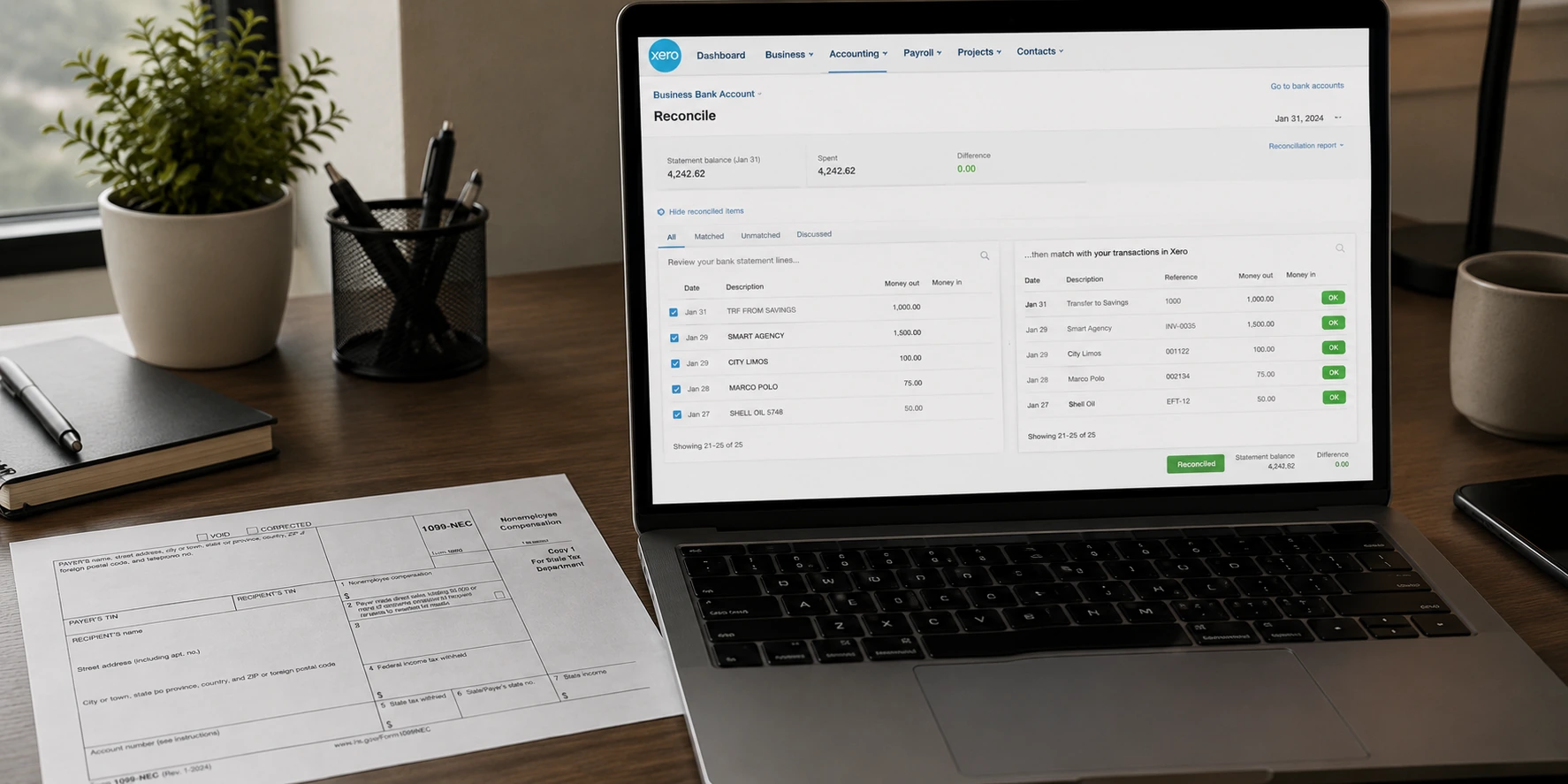
Hiring help for your business may seem simple. Maybe they work flexible hours or get paid per project, so you label them a contractor, skip payroll taxes, and move on.
But it’s not always that straightforward.
If the IRS later determines the worker should have been classified as an employee, your business can be held responsible for all unpaid payroll taxes, plus penalties and interest. This is called misclassification, and it happens more often than you might think.
TL;DR: Misclassifying an employee as a contractor can cost a business thousands. The IRS doesn’t let that slide, and the back taxes and penalties that follow can seriously hurt your business. Here’s what to know about employee vs contractor tax rules before you file.
What’s the Actual Difference Between an Employee and a Contractor?

The label you put on someone doesn’t matter to the IRS. What matters is the reality of the working relationship. The IRS looks at three main areas:
- Behavioral control: Do you set their schedule, provide training, or dictate how they work? That points to an employee.
- Financial control: Does the worker have multiple clients and their own tools? Contractors typically operate independently.
- Type of relationship: Are benefits involved? Is the work central to your business? These suggest an employment relationship.
No single factor decides it. The IRS looks at the full picture. You can read the IRS’s official worker classification guidance here.
What Are the Tax Rules for Each?
Understanding the employee vs contractor IRS tax rules comes down to who is responsible for paying taxes.
For employees:
- You withhold federal and state income tax from their paycheck
- You pay half of their Social Security and Medicare taxes (FICA)
- You issue a W-2 at the end of the year
- You may owe federal and state unemployment taxes
For independent contractor tax obligations:
- You do not withhold taxes
- The contractor pays their own self-employment taxes
- You issue a 1099-NEC if you paid them $600 or more in the year
- No unemployment taxes apply
So, as an employer, contractors look attractive on paper. Less paperwork, lower tax burden. But only if the classification is actually correct.
What Are the Contractor Misclassification Penalties?

If the IRS determines you misclassified a worker, here’s what will happen:
- Back payroll taxes for the employee and employer share.
- Failure-to-withhold penalties, up to 100% of unpaid taxes.
- An interest that doubles with time.
- Separate state-level fines.
The IRS offers the Voluntary Classification Settlement Program for businesses that want to correct past mistakes at a reduced cost. Coming forward before the IRS finds the issue is always the better move.
What to Know About Employee vs Contractor Massachusetts Tax Rules
If your business is based in Massachusetts or employs workers here, pay close attention. Massachusetts uses a strict three-part test to classify workers, and it’s more stringent than the IRS standard.
Under Massachusetts law, a worker is considered an employee unless the hiring business can prove all three of the following:
- The worker is free from the company’s control and direction.
- The work performed is outside the company’s usual course of business.
- The worker independently establishes themselves in that type of work.
It is called the ABC test, and it’s one of the toughest in the country. Many businesses that would be fine under IRS employee vs contractor tax rules still run into problems at the state level.
What You Should Do Right Now

Tax season is already here. If you have contractors on your books, it’s a good time to ask:
- Did I issue 1099-NEC forms for everyone I paid $600 or more last year?
- Do my “contractors” function like employees?
- Am I confident in how these workers are classified if the IRS asks?
If there’s any doubt, get a professional review. The cost is a fraction of what penalties can run.
At JBS Corp, we help businesses across the country navigate exactly these kinds of tax questions. Whether you’re in Lawrence, Methuen, or anywhere else in the US, our team can review your contractor and employee setup and make sure you’re filing correctly.
Schedule a tax appointment with JBS Corp before the season gets away from you.
Note: All figures, percentages, and tax rules are subject to change and this article may not reflect the most recent updates; visit IRS.gov for the most current information.