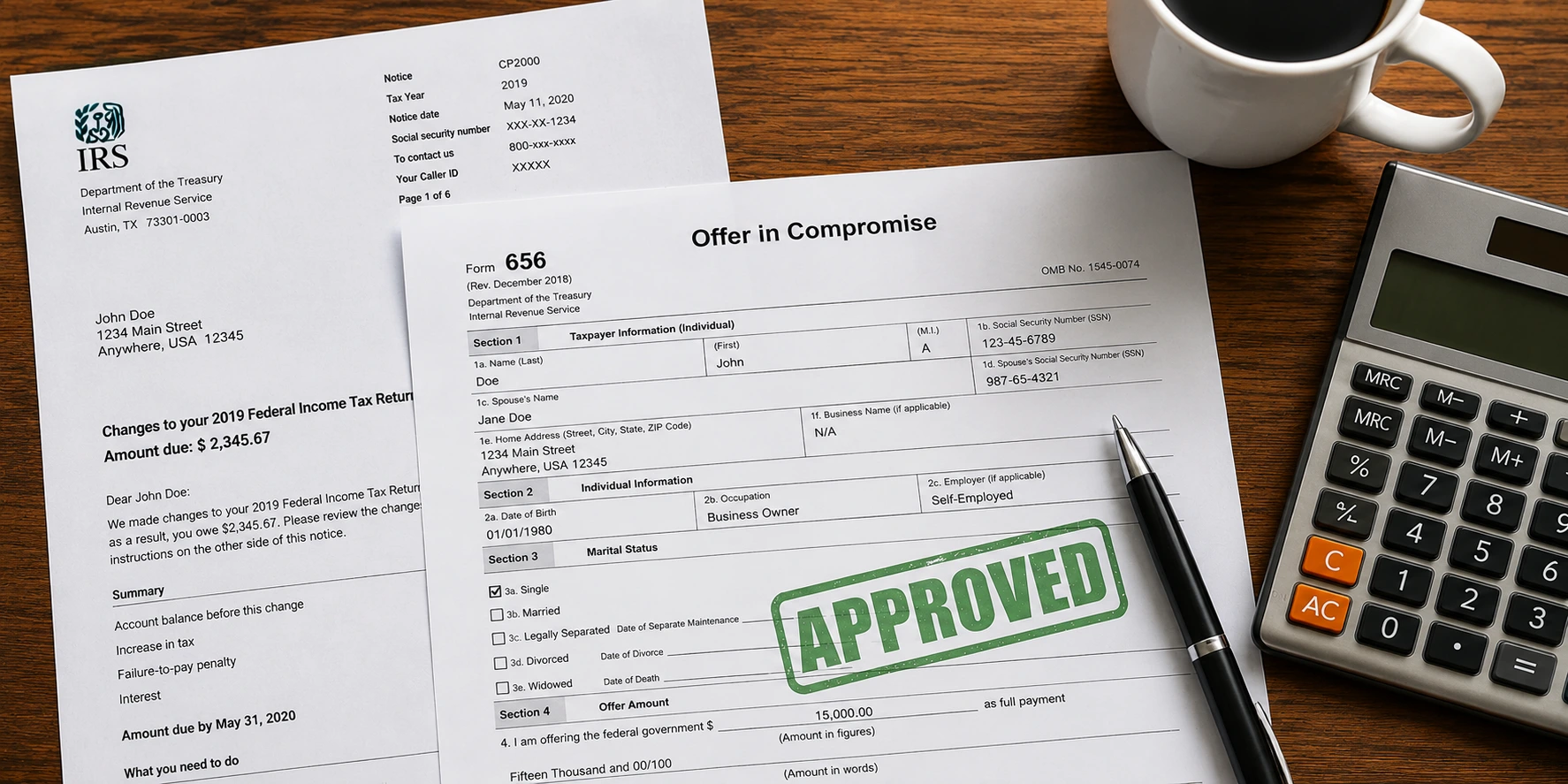
Owing more in back taxes than you can realistically pay is a stressful position, and many taxpayers assume their only choices are paying in full or facing endless collection notices. The IRS actually offers a formal path for settling tax debt for less than the full amount owed, known as an Offer in Compromise.
An Offer in Compromise, or OIC, is not a shortcut and it is not available to everyone who owes money to the IRS. The program exists for taxpayers whose financial circumstances make full payment genuinely unlikely, and the IRS evaluates every application against a specific set of financial standards before deciding whether to accept it.
TL;DR: An Offer in Compromise allows certain taxpayers to settle federal tax debt for less than the full balance owed, based on what the IRS calculates they can reasonably pay. Eligibility depends on filing compliance, current estimated payments, and a financial review known as Reasonable Collection Potential. Only a portion of submitted offers are accepted each year, which makes accurate preparation and realistic expectations important before applying.
How Does An Offer In Compromise Work?

The IRS accepts an Offer in Compromise when it determines that the amount offered represents the most it can reasonably expect to collect from a taxpayer within a reasonable period of time. This determination is based on a calculation called Reasonable Collection Potential, which combines the equity in a taxpayer’s assets with their available future income. If the RCP is lower than the total tax debt owed, an offer at or above that number has a realistic chance of acceptance.
This is a math-driven process rather than a hardship request in the way many taxpayers expect. The IRS reviews income, allowable living expenses under its National Standards, and the value of property such as real estate, vehicles, and bank accounts. Taxpayers who do not qualify based on adjusted gross income may request a waiver based on their household’s current gross monthly income. A taxpayer with modest assets and limited disposable income is far more likely to see an offer accepted than someone with significant equity or earning capacity who proposes a low settlement amount.
Do I Qualify For An Offer In Compromise?
Before the IRS will even consider the financial numbers, a taxpayer has to clear a set of basic requirements. Eligibility requires having filed all required tax returns and made all required estimated payments, and not being in an open bankruptcy proceeding. Taxpayers who still have unfiled returns or who have fallen behind on current year estimated payments will generally need to resolve those issues first, since an incomplete filing history signals to the IRS that the account is not yet stable enough to evaluate.
For freelancers and real estate investors in particular, staying current on quarterly estimated payments is often the piece that gets overlooked, and it can stall an otherwise reasonable offer.
How to Apply For An Offer In Compromise
Forms And Documentation
Applying involves submitting Form 656 along with a Collection Information Statement, either Form 433-A for individuals or Form 433-B for businesses, laying out income, expenses, assets, and liabilities in detail. Taxpayers can use the Offer in Compromise Pre-Qualifier Tool to get a sense of whether they may qualify before formally applying. This tool provides a preliminary estimate only, and the IRS makes the final determination after reviewing the full application. The IRS Offer in Compromise FAQ page walks through the AGI thresholds and low income certification rules in more detail.
Fees And Payments
Application fees and initial payments apply in most cases, though taxpayers who meet the low income certification guidelines are not required to submit the application fee or payments while the offer is under consideration. Because the IRS reviews years of financial detail during this process, incomplete or inconsistent documentation is one of the most common reasons an offer gets rejected or returned.

What Happens If My Offer In Compromise Is Rejected?
Not every offer is accepted, and taxpayers whose RCP calculation is higher than what they proposed should expect a denial. When that happens, there are other paths worth exploring. Currently Not Collectible status, for example, can pause active collection while a taxpayer’s financial situation is reviewed, even if it does not settle the debt outright.
Taxpayers should also be cautious of firms that promise guaranteed settlements before reviewing any financial details. The IRS has specifically warned about so-called offer in compromise mills that market aggressively to people who clearly do not meet the qualifications. In some cases, penalty relief can also reduce the total balance owed before an offer is ever submitted.
Working Through The Offer In Compromise Process With Support
An Offer in Compromise can provide real relief for taxpayers facing debt that has become unmanageable, but the outcome depends heavily on accurate financial reporting and a realistic understanding of what the IRS is likely to accept. JBS provides tax services to individuals, freelancers, and real estate investors working through IRS debt resolution, and our team can help review your financial picture, prepare the required forms, and set expectations before you submit an offer.
For the most current program details, including the Pre-Qualifier Tool and the full Offer in Compromise Booklet, visit IRS.gov.
Note: This article is for educational purposes only and does not constitute tax advice. Tax rules, figures, and percentages are subject to change and this article may not be fully up to date; visit IRS.gov for the most current information and consult a tax professional for guidance specific to your situation.