
The Saver’s Credit, formally known as the Retirement Savings Contributions Credit, rewards lower and moderate income earners for putting money into a retirement account. Many taxpayers who qualify never claim it, largely because they do not know it exists.
TL;DR: The Saver’s Credit is a nonrefundable federal tax credit worth up to $1,000 for individuals and $2,000 for married couples filing jointly who contribute to a qualified retirement account, with eligibility based on income, filing status, age, and student or dependent status. Taxpayers claim it by filing Form 8880 alongside their federal tax return.
What Is The Saver’s Credit?
The Saver’s Credit gives eligible taxpayers a direct reduction in the taxes they owe based on a percentage of what they contribute to an IRA, 401(k), 403(b), SIMPLE IRA, or similar employer sponsored plan. The credit rate is 50%, 20%, or 10% of the first $2,000 contributed by an individual, or $4,000 for a married couple filing jointly when both spouses contribute and qualify.
How The Saver’s Credit Reduces Your Tax Bill
A tax credit works differently from a deduction. A deduction lowers the income used to calculate your tax, while a credit lowers the tax bill itself, dollar for dollar. Because the Saver’s Credit is nonrefundable, it can reduce your tax liability to zero but will not generate a refund beyond what you already owe, and any unused portion does not carry forward to future years.
Who Qualifies For The Saver’s Credit?
Qualifying comes down to three factors: income, filing status, and a handful of eligibility rules set by the IRS.
Income Limits For 2026
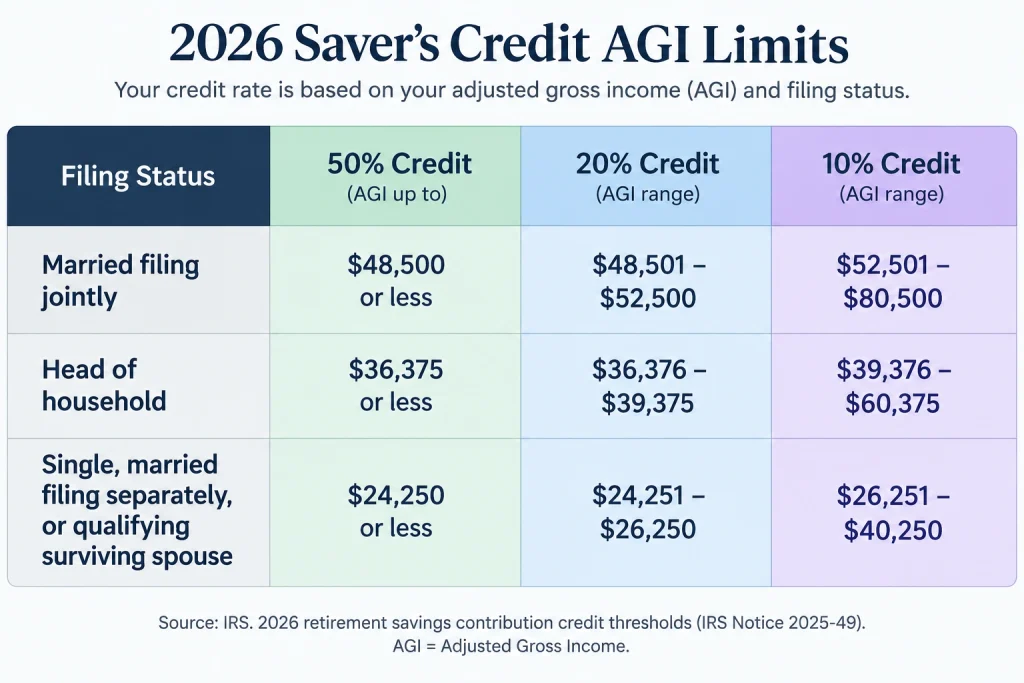
For the 2026 tax year, the IRS set the following adjusted gross income thresholds for each credit rate:
- Married filing jointly: 50% credit at AGI up to $48,500; 20% credit from $48,501 to $52,500; 10% credit from $52,501 to $80,500.
- Head of household: 50% credit at AGI up to $36,375; 20% credit from $36,376 to $39,375; 10% credit from $39,376 to $60,375.
- Single, married filing separately, or qualifying surviving spouse: 50% credit at AGI up to $24,250; 20% credit from $24,251 to $26,250; 10% credit from $26,251 to $40,250.
Taxpayers above these thresholds do not qualify for the credit in that filing category. These figures are adjusted for inflation each year, so it helps to confirm current limits before filing.
Additional Eligibility Requirements
Beyond income, the IRS requires that a taxpayer be at least 18 years old, not claimed as a dependent on someone else’s return, and not enrolled as a full-time student during any part of the tax year. Contributions made through payroll deferral, direct IRA deposits, and certain rollovers can all count toward the credit, though the specific rules vary by account type.
How To Claim The Saver’s Credit
Claiming the credit requires filing Form 8880 with your federal tax return. The form walks through your contributions, filing status, and income to calculate the exact credit percentage that applies. Our team at JBS often finds that clients who contribute to a workplace retirement plan already have the documentation they need through their year end statements, which makes the form straightforward to complete alongside a standard tax return.
Why The Saver’s Credit Matters For Freelancers And Small Business Owners

Freelancers and self-employed workers without access to an employer plan can still qualify for the Saver’s Credit through a traditional or Roth IRA, a SEP IRA, or a solo 401(k). For newer entrepreneurs reinvesting most of their income back into a growing business, pairing retirement contributions with the credit can make consistent saving more realistic.
Retirement savings decisions rarely happen in isolation from the rest of a tax picture, and the Saver’s Credit is one of several tools worth reviewing during year round tax planning rather than waiting until filing season. For the most current thresholds and eligibility details, the IRS Retirement Savings Contributions Credit page is the authoritative source.
Note: This article is for educational purposes only and does not constitute tax advice. Tax rules, figures, and percentages are subject to change and this article may not be fully up to date; visit IRS.gov for the most current information and consult a tax professional for guidance specific to your situation.