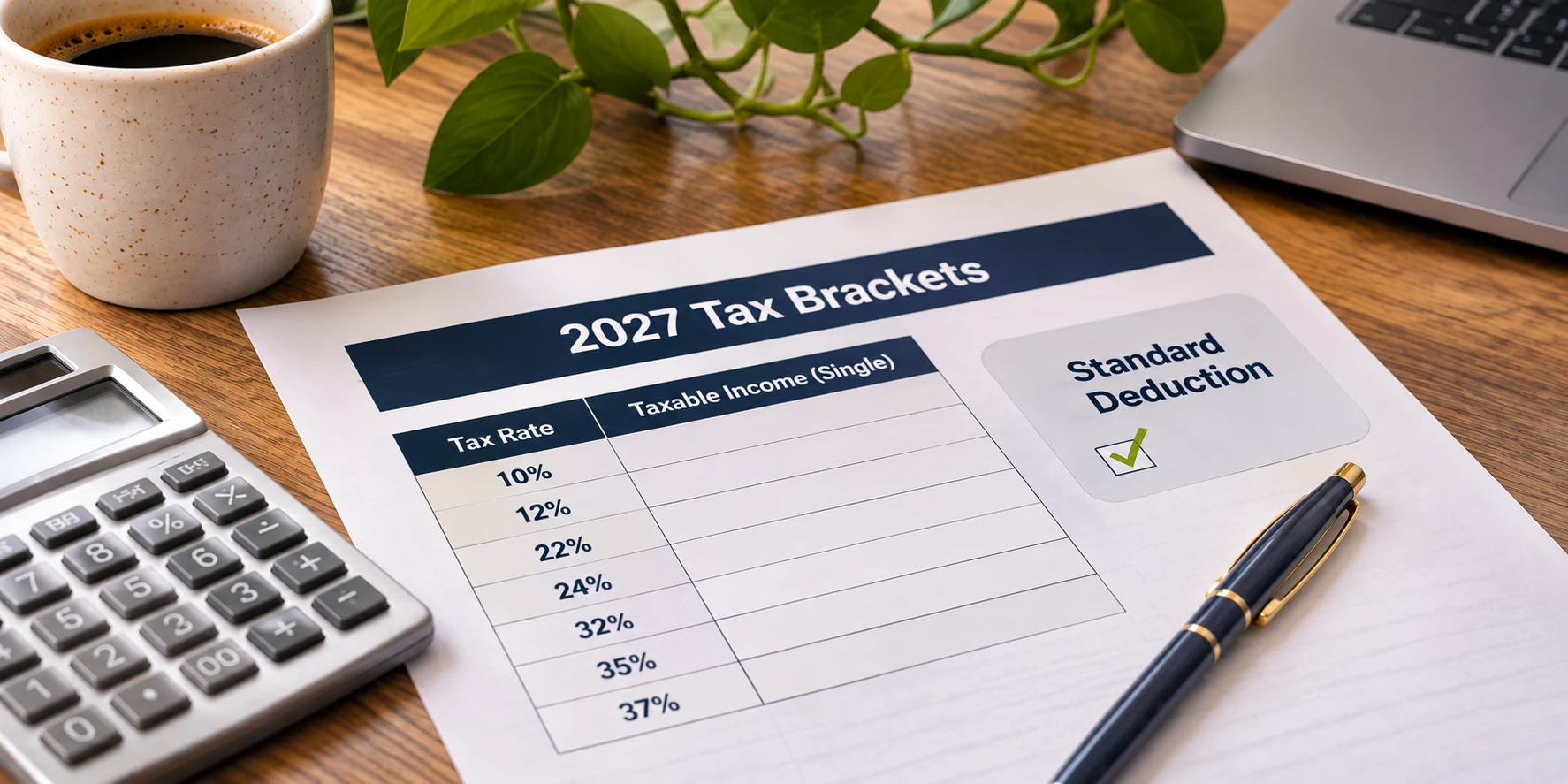
On November 5, 2026, the IRS released its annual inflation adjustments for tax year 2027, updating nearly 70 provisions that include the federal income tax brackets and the standard deduction. These figures apply to income earned during 2027 and to the returns most people will file in early 2028. Reviewing the new thresholds now gives individuals, freelancers, and small business owners a full year to plan withholding, estimated payments, and deductions with confidence.
TL;DR: The seven federal income tax rates stay the same for 2027, while the income thresholds for each bracket rise with inflation and the standard deduction climbs to $33,200 for married couples filing jointly. Several credits and limits also increase, including the Child Tax Credit, Section 179 expensing, and the annual gift exclusion.
What Are The 2027 Federal Income Tax Brackets?
The rates of 10%, 12%, 22%, 24%, 32%, 35%, and 37% carry over from 2026. The income ranges attached to each rate move up to account for inflation, which helps keep a cost-of-living raise from pushing more of your income into a higher bracket. The U.S. uses a marginal system, so each rate applies only to the portion of taxable income that falls within that bracket.
2027 Tax Brackets For Single Filers And Married Couples Filing Jointly
| Tax Rate | Single Filers (Taxable Income) | Married Filing Jointly (Taxable Income) |
| 10% | $0 to $12,800 | $0 to $25,600 |
| 12% | $12,801 to $52,025 | $25,601 to $104,050 |
| 22% | $52,026 to $109,125 | $104,051 to $218,250 |
| 24% | $109,126 to $208,325 | $218,251 to $416,650 |
| 32% | $208,326 to $264,550 | $416,651 to $529,100 |
| 35% | $264,551 to $661,375 | $529,101 to $793,650 |
| 37% | Over $661,375 | Over $793,650 |
Full rate schedules for every filing status, including heads of household, appear in Revenue Procedure 2026-35, which is available through the IRS newsroom. The IRS also maintains a helpful overview of federal income tax rates and brackets.
How Marginal Rates Work In Practice
Consider a single filer with $60,000 of taxable income in 2027. The first $12,800 is taxed at 10%, the next $39,225 is taxed at 12%, and the remaining $7,975 is taxed at 22%. The total federal income tax comes to about $7,742, an effective rate of roughly 12.9%. Landing in the 22% bracket means only the top slice of income is taxed at that rate.
2027 Standard Deduction Amounts
The standard deduction reduces taxable income before the brackets apply. For 2027, the amounts are:
- $16,600 for single filers and married individuals filing separately
- $24,925 for heads of household
- $33,200 for married couples filing jointly, up $1,000 from 2026
Taxpayers whose mortgage interest, state and local taxes, and charitable gifts add up to more than these amounts may benefit from itemizing instead. Under the Working Families Tax Cuts, the overall limitation on itemized deductions remains repealed, although taxpayers in the 37% bracket face a cap on the tax benefit those deductions provide. Personal exemptions remain at zero.
Other 2027 Adjustments Worth Knowing
Credits For Families
The maximum Child Tax Credit rises to $2,300 per qualifying child, with up to $1,800 refundable. The maximum Earned Income Tax Credit reaches $8,496 for taxpayers with three or more qualifying children, and the adoption credit covers qualified expenses up to $18,250.

Limits For Small Business Owners And Freelancers
Businesses can expense up to $2,640,000 of Section 179 property in 2027, with a $33,100 limit for sport utility vehicles. Employees can set aside up to $3,500 in a health flexible spending arrangement, and the monthly limit for qualified transportation and parking benefits increases to $350. The maximum employer-provided childcare credit grows to $515,943.67, or $619,132.40 for eligible small businesses.
Estate And Gift Thresholds
The basic estate tax exclusion increases to $15,480,000 for decedents who die in 2027, and the annual gift exclusion rises to $20,000 per recipient.
How To Plan Ahead For The 2027 Tax Year
Updated brackets are a good prompt to review your paycheck withholding with the IRS Tax Withholding Estimator, especially after a raise, a marriage, or a new child. Freelancers and self-employed professionals can use the new thresholds to recalculate quarterly estimated payments, and real estate investors can factor the brackets into the timing of a property sale, which we cover in our guide to taxes before you sell your home.
JBS provides tax services to individuals, freelancers, and real estate investors, with planning that looks ahead to next year’s return. Business owners can lean on our business tax services and bookkeeping and controllership team to keep records ready for Section 179 and other year-end decisions. As a Xero Platinum Partner, our team uses Xero to track equipment purchases, payroll, and benefit costs throughout the year, so the figures behind each 2027 limit are organized well before filing season. To review how the 2027 changes affect your situation, schedule a conversation with our team.
Frequently Asked Questions About The 2027 Tax Brackets
When Do The 2027 Tax Brackets Take Effect?
The 2027 brackets apply to income earned from January 1 through December 31, 2027, and to the federal returns most people will file in early 2028. Returns filed in 2027 still use the 2026 figures.
Did The Federal Income Tax Rates Change For 2027?
The seven rates of 10%, 12%, 22%, 24%, 32%, 35%, and 37% remain the same. The IRS adjusted the income thresholds for each bracket to reflect inflation.
What Is The 2027 Standard Deduction?
The standard deduction is $16,600 for single filers and married individuals filing separately, $24,925 for heads of household, and $33,200 for married couples filing jointly.
How Much Income Is Taxed At The Higher Rate After Moving Into A New Bracket?
Only the income above the bracket threshold is taxed at the higher rate. A single filer with $53,000 of taxable income in 2027 pays 22% on the $975 above $52,025, while the rest of that income is taxed at 10% and 12%.
How Much Is The Child Tax Credit For 2027?
The maximum Child Tax Credit is $2,300 per qualifying child, and up to $1,800 of that amount may be refundable.
Where Can Heads Of Household Find Their 2027 Tax Brackets?
Bracket thresholds for heads of household and every other filing status are published in Revenue Procedure 2026-35, available through the IRS newsroom. Our team can also walk through the numbers that apply to your return.
Note: This article is for educational purposes only and does not constitute tax advice. Tax rules, figures, and percentages are subject to change and this article may not be fully up to date; visit IRS.gov for the most current information and consult a tax professional for guidance specific to your situation.